
What is a USDA approved warehouse
A "USDA approved warehouse" is not a single, universal designation. The term refers to a facility that holds either a voluntary federal license under the United States Warehouse Act (USWA) for commodity storage and financing, or a specific contractual agreement with a USDA agency like the Commodity Credit Corporation (CCC) to store government-owned goods.
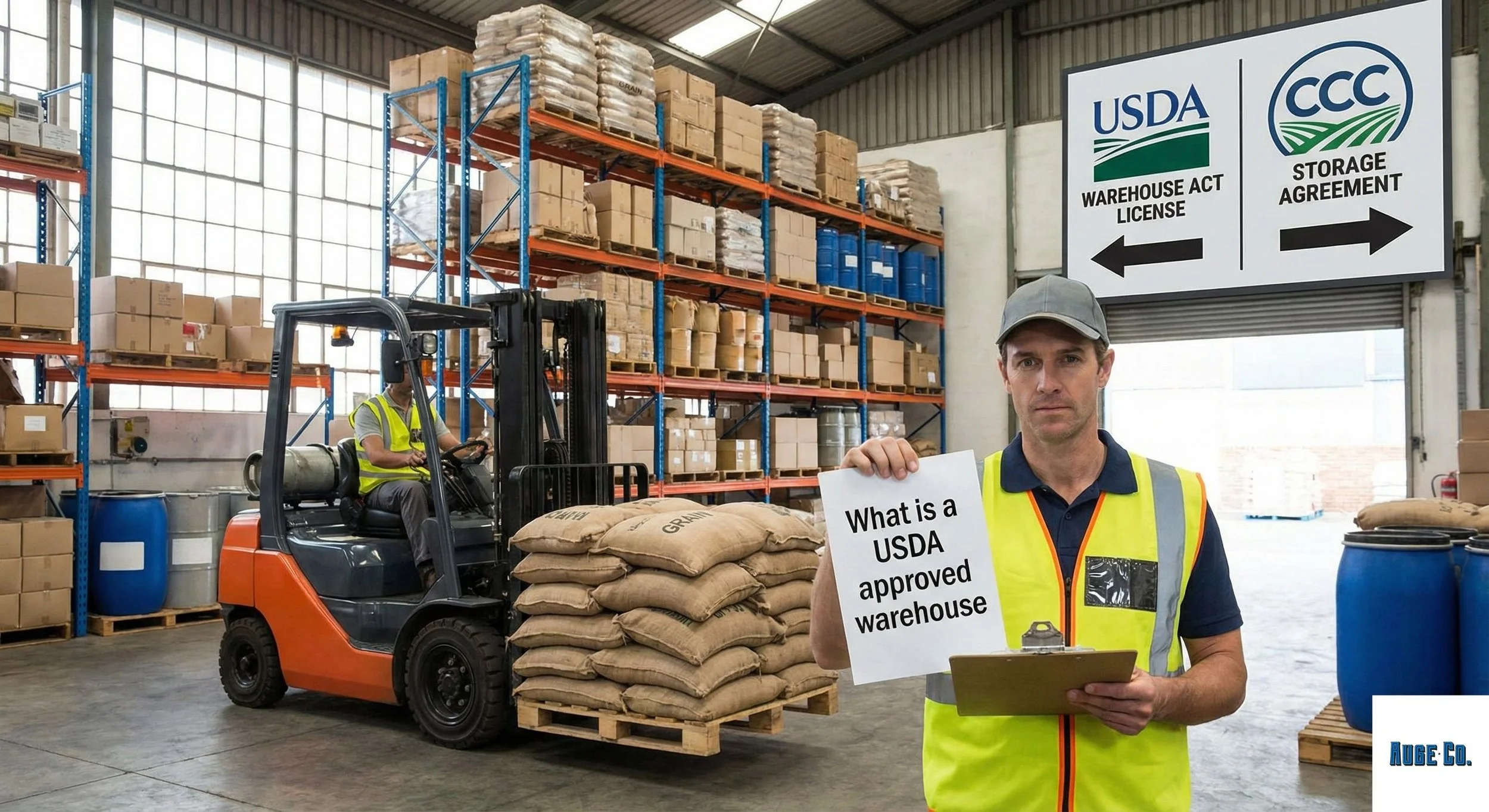
The Myth of the "USDA Approved" Label: What Does It Really Mean?
In the world of logistics, agriculture, and food distribution, the term "USDA approved" is used so frequently it seems self-explanatory. Business owners often seek out a "USDA approved warehouse" believing it’s a simple, one-size-fits-all certification of quality. The reality is far more nuanced and critically important for your business's success. Believing this myth can lead to costly mistakes, such as choosing a facility that can’t legally handle your specific commodity or one that lacks the credentials to support your financing needs.
The core of the issue is that there is no single "USDA Approved" stamp that covers all warehouse activities. Instead, the United States Department of Agriculture (USDA), the federal agency overseeing America's vast food, agriculture, and forestry sectors, interacts with warehouses in several distinct ways. What "USDA verified" means depends entirely on the context—whether you're storing raw grain, distributing frozen meat, or participating in a government food program. The right choice of storage partner depends on a deep understanding of these distinctions.
Understanding the Three Primary Warehouse Categories
Before diving into the specifics of government oversight, it's helpful to understand the basic types of warehouses operating in the supply chain. Generally, facilities fall into one of three categories, with the lines often blurring based on their services and licensing.
Private Warehouse: This type of facility is owned and operated by the same company that owns the goods being stored. A large food manufacturer, for instance, might own a private warehouse to store its own processed commodities before they are shipped to retailers.
Public Warehouse: This is the most common model for third-party logistics (3PL). A public warehouse is a business that offers storage and related services to other companies. They are the backbone of modern supply chain management, providing everything from bulk commodity storage to sophisticated cold chain logistics.
Government/Bonded Warehouse: This category overlaps with public warehouses. A bonded warehouse is a facility that has met specific state or federal requirements, including securing a surety bond to protect the owners of the goods being stored. The federal USWA license and many state-level licenses fall under this umbrella, ensuring financial assurance for depositors.
Understanding which type of warehouse you need is the first step. The second, more crucial step, is verifying its specific government licenses and agreements, which dictate its true capabilities.
The Two Faces of Federal Oversight: USWA vs. CCC Agreements
When most people in the agricultural sector talk about a federally approved warehouse, they are usually referring to one of two distinct federal relationships: a license under the United States Warehouse Act (USWA) or a storage agreement with the Commodity Credit Corporation (CCC). They are not interchangeable, and confusing them can have significant consequences for your operations.
The United States Warehouse Act (USWA): A Mark of Financial Integrity
The United States Warehouse Act (USWA), which provides the basis for federal licensing, was enacted in 1916 to build confidence in the national warehousing system. A USWA license is a voluntary but powerful credential for a warehouse operator. It signifies that the facility has met stringent federal standards for financial stability, operational soundness, and integrity. Licensed warehouses are subject to regular, unannounced warehouse examination audits by a licensed warehouse examiner to ensure ongoing compliance.
The single most important function of a USWA license is its ability to enable the issuance of legally sound warehouse receipts. A warehouse receipt from a USWA-licensed facility is a document of title, considered a highly reliable form of collateral. This makes it an indispensable tool for producers seeking commodity loans and for commodity brokers engaged in trading. The advent of the Electronic Warehouse Receipt (EWR) has further streamlined this process, making financing and trading faster and more secure. This is a critical component of risk management in the agricultural sector, providing liquidity and stability to the market for everything from corn storage to cotton.
Commodity Credit Corporation (CCC) Agreements: A Contract for Government Business
A Commodity Credit Corporation (CCC) storage agreement is entirely different. The CCC is a government-owned corporation within the USDA, created to stabilize, support, and protect farm income and prices. It buys and stores vast quantities of agricultural commodity products as part of price support programs and other initiatives.
To store these government-owned goods, a warehouse must enter into a Uniform Grain and Rice Storage Agreement (UGSA) or a similar contract with the CCC. This is not a license; it is a business contract. The warehouse agrees to store the CCC's property according to specific terms, conditions, and payment rates. While the warehouse must meet certain standards to qualify, the agreement is purely for the purpose of doing business with the CCC. It does not confer the same broad benefits as a USWA license, nor does it automatically allow the warehouse to issue the kind of federally recognized warehouse receipts used for private-sector financing.
Navigating the Complex Web of State vs. Federal Regulation
Adding another layer of complexity is the role of state governments. The U.S. has a system of dual sovereignty, and warehouse regulation is a perfect example. Warehouses can be regulated by either state or federal government, depending on the entity with which the warehouse is licensed. A warehouse operator must choose whether to seek a federal license under the USWA or a license from their state's department of agriculture (if one exists).
This state vs. federal choice has significant implications. Many states, particularly in the agricultural Midwest, have robust warehouse licensing programs that include bonding requirements and indemnity funds to protect producers from financial loss if a grain elevator fails. For a farmer storing grain locally, a state-licensed facility can offer excellent protection.
However, the power of a federal USWA license is its national uniformity and recognition. In many cases, a warehouse holding a federal license is exempted from needing a state license, simplifying compliance for operators with facilities in multiple states. Furthermore, for businesses involved in interstate commerce or international trade, a USWA license carries more weight and provides greater utility. This is especially true when a bill of lading is used for logistics and transportation across state lines.
Crucially, this regulatory landscape is not consistent across the country. State-level regulation of grain warehouses is not uniform; several states, including California, Florida, and Arizona, do not have state-level regulations. In these states, a federal USWA license is the primary, and often only, option for a warehouse to demonstrate this level of bonded, audited assurance for storing an agricultural commodity.
A Comparative Look: USWA License vs. CCC Agreement vs. State Regulations
Choosing a warehouse partner requires weighing the pros and cons of their specific regulatory standing. Using a stacked list format helps clarify these differences for a confident decision.
Federal United States Warehouse Act (USWA) License
Pros: Provides national recognition and uniform standards. Enables the creation of federally recognized warehouse receipts essential for commodity trading and securing financing. Involves rigorous federal compliance audits and high standards for financial assurance. Can often satisfy state-level licensing requirements, simplifying operations for multi-state companies.
Cons: The application for license is a demanding and potentially costly process. The license is voluntary, meaning many excellent, reliable warehouses may operate without one (often under state regulation). The USWA primarily focuses on raw, storable agricultural products like grain, cotton, and rice, not necessarily processed or refrigerated goods.
Program-Specific USDA Agreements (e.g., for CCC)
Pros: Absolutely essential for any warehouse wanting to store government-owned commodities as part of USDA price support programs or food aid distribution. Confirms the facility meets the specific sanitation standards and logistical requirements of that particular government contract.
Cons: This is a contractual agreement, not a license. Its scope is extremely narrow and applies only to the specific program. It does not grant the warehouse broad authority to issue negotiable warehouse receipts for general commerce and is not a substitute for a USWA or state license for protecting other depositors' goods.
State-Level Warehouse Regulations
Pros: Can be perfectly sufficient for local and regional producers and businesses. Often includes specific protections tailored to the state's agricultural economy, such as state-managed indemnity funds that reimburse farmers in case of a warehouse's financial failure. The warehouse operator may be more familiar with local agricultural practices.
Cons: The quality and requirements of state regulations vary dramatically from one state to another, with some states having no regulations at all. A state license may not be recognized or valued by out-of-state lenders or buyers. It is less useful for businesses engaged in national or international commerce.
Why the *Type* of Approval is Critical for Your Business Operations
Understanding these differences isn't just an academic exercise; it has a direct impact on your supply chain's efficiency, security, and cost. The right credentialing ensures a warehouse has the specific capabilities you need.
For example, a food bank contractor distributing items for the National School Lunch Program (NSLP) or The Emergency Food Assistance Program (TEFAP) absolutely needs a partner with the correct USDA agreements. The warehouse must adhere to strict traceability and handling protocols unique to these programs. Similarly, a commodity trader in Chicago or Kansas City would be unable to conduct business effectively without using USWA-licensed warehouses, as the integrity of the electronic warehouse receipt is paramount.
However, a distributor of imported frozen foods might find that neither a USWA license nor a CCC agreement is relevant. Their primary concern is a facility that meets Food and Drug Administration (FDA) standards under the Food Safety Modernization Act (FSMA), has robust Hazard Analysis Critical Control Point (HACCP) plans, and holds a third-party audit certification like one from the Safe Quality Food (SQF) Institute or BRC Global Standards. These are better indicators of expertise in food grade warehouse operations for processed or refrigerated items.
Ultimately, the license or agreement is just one piece of the puzzle. The true value of a warehouse partner is their ability to solve problems and perform reliably under pressure. When unforeseen challenges arise—and in logistics, they always do—you need a team that acts as an extension of your own. As one of our clients, Alicia, shared after a difficult situation:
"These guys are the BEST! Helped me out when our driver's clutch went out! Unloaded and loaded our new driver in no time! Reach out to them if you're ever in a pinch. Alicia was AWESOME! 10/10!!!"
This kind of responsive, problem-solving service is what keeps a supply chain moving. It's the human element of reliability that no government form can fully capture but is often found in facilities committed to the high operational standards that these licenses represent.
Key Decision Factors: Matching Your Needs to the Right Warehouse
To make a confident decision, analyze your specific needs against these four critical factors. The right choice will become clear when you know what to prioritize.
Commodity Type
Are you storing raw agricultural commodities or processed food products? For bulk storage of farm products like wheat storage, soybean storage, or corn, a USWA or state-licensed grain elevator is essential. The commodity grading provided at these facilities, often aligned with Federal Grain Inspection Service (FGIS) standards, is part of the value. For processed or perishable goods, such as dairy products storage or meat and poultry, you should prioritize different credentials. Here, compliance with USDA's Food Safety and Inspection Service (FSIS) or Agricultural Marketing Service (AMS) programs like Shell Egg Surveillance is far more relevant than a USWA license. These agencies focus on food safety, not commodity storage as a financial asset.
Geographic Location
Where your business operates matters immensely. If you are a producer in the Corn Belt, you may have numerous excellent state-licensed options nearby. However, if you are operating in a state with no specific warehouse laws or are located near a major logistics hub like the Port of Long Beach or the Port of New Orleans for import/export compliance, a federally licensed USWA warehouse provides a more reliable and universally accepted standard of quality assurance.
Need for Financing and Commerce
Is the stored commodity part of your financing strategy? If you plan to use your stored goods as collateral for a loan or intend to trade them on a commodity market, a USWA-licensed warehouse is non-negotiable. The legal and financial security of a USWA warehouse receipt is the foundation of this system. State-level receipts may not be accepted by national lenders or trading partners, limiting your commercial options.
Participation in Government Programs
If your business model involves storing commodities for or selling to the federal government, you must use a warehouse that holds the specific agreement required by that program. This most often means a CCC storage agreement for price support programs managed by the Farm Service Agency (FSA). Do not assume a USWA or state license automatically qualifies a facility for this work; it is a separate and distinct contractual relationship.
Beyond the Label: How to Verify a Warehouse's Status
Trust, but verify. Do not take a warehouse's marketing claims at face value. Fortunately, the USDA provides public resources to check a facility's credentials. This is the most effective way to move beyond the confusing "USDA approved" label and find the specific qualifications that match your business needs.
For federally licensed warehouses, the process is straightforward. The USDA's Farm Service Agency (FSA) is the publisher and maintainer of the dataset of active USWA licensed warehouses. This public database lists all currently licensed facilities, their locations, and the commodities they are authorized to store. A quick search can confirm a warehouse's status in minutes, providing you with definitive proof.
It's also important to understand what USDA data is *not* a form of approval. For instance, the USDA's National Agricultural Statistics Service (NASS) publishes a biennial report on the 'Capacity of Refrigerated Warehouses', which is a data collection activity, not a regulatory approval or licensing process. A warehouse appearing in this report is not "approved," it has simply been counted in a survey. Being aware of these distinctions helps you filter out irrelevant information.
When you access these official government resources, you are often interacting with complex digital documents. If you download an official USDA form as a PDF, for instance, you're not just getting a simple file. That document is a digital xobject, a container of information. The file's internal code is a data stream that includes technical commands and resources for rendering the content. Within this stream, you might find code snippets like `subtype form` or `rg 57 14` which are instructions for the software to draw the elements correctly. The process to `endstream` and `endobj` properly closes these data objects, ensuring the PDF is readable. Understanding this technical layer isn't necessary for most users, but it highlights the structure and precision behind the official records you rely on for verification.
Answering Your Core Questions
Let's directly address some of the most common questions that arise from this complex topic.
How Do I Become a USDA Approved Vendor?
As we've established, there is no single "USDA approved vendor" status. The path depends entirely on your business goal.
To operate a federally licensed warehouse: You must complete the rigorous application for license under the USWA, which includes demonstrating financial stability, securing proper bonding, and passing an initial examination.
To store government commodities: You must monitor federal contract opportunities and bid on a storage agreement with the CCC or other relevant agencies, meeting all the requirements laid out in the contract proposal.
To sell food to the USDA: You must register as a federal contractor and meet the specific quality and safety standards of the purchasing agency, such as AMS or FSIS, which have their own vendor approval processes.
Are All USDA Designations Related to Storage?
Absolutely not. The USDA is a massive organization with many different agencies and responsibilities. The stamp on a package of meat comes from the Food Safety and Inspection Service (FSIS) and certifies that the processing plant met federal sanitation and safety standards. The "USDA Organic" label is a certification managed by the Agricultural Marketing Service (AMS) verifying that a farm has followed organic practices. An Animal and Plant Health Inspection Service (APHIS) certificate may be required for import/export compliance. These are all types of USDA "approval" or verification, but they are completely separate from the licensing of a warehouse for the storage of an agricultural commodity.
Making the Right Choice for Your Needs
There is no single "best" type of warehouse. The optimal choice is the one that aligns perfectly with your commodity, your business model, and your risk tolerance. Here is our tailored advice for different user profiles.
For the Agricultural Producer (Farmer)
Your primary concern is the financial security of your harvested crop. You need to know that if the warehouse you choose goes out of business, you will be compensated. Both federally licensed USWA warehouses and many state-licensed facilities offer strong protection through bonding requirements. Investigate your state's specific laws; a state with a dedicated indemnity fund may offer an extra layer of security that is very appealing for your peace of mind.
For the Food Distributor or Retailer
Your focus is on food safety, inventory management, and efficient logistics. A USWA license is likely not your top priority. Instead, you need a third-party logistics (3PL) partner with impeccable cold storage facility operations, a state-of-the-art warehouse management system for traceability, and certifications that demonstrate food safety excellence (SQF, BRC, GMP, HACCP). Their ability to manage the cold chain and provide reliable transportation is far more valuable than a federal commodity license.
For the Commodity Trader
Your business lifeblood is the validity and liquidity of warehouse receipts. For you, there is no substitute for a federally licensed USWA warehouse. The integrity of the USWA-backed electronic warehouse receipt (EWR) is what allows for the smooth, secure, and rapid execution of trades and financing. Using a non-USWA facility introduces unacceptable risk and will severely limit your ability to operate in the national commodity markets.
Ultimately, navigating the complexities of warehouse regulations is about finding a partner who not only holds the right credentials but also embodies a culture of reliability and customer-focused problem-solving. At Auge Co. Inc., we have spent decades building that trust by providing customized solutions tailored to the unique needs of each client. For a personalized assessment of your storage and logistics needs from our expert team in San Antonio, TX, contact us today for a free quote and discover the peace of mind that comes from working with a truly dependable partner.