
What is ambient or controlled room temperature storage?
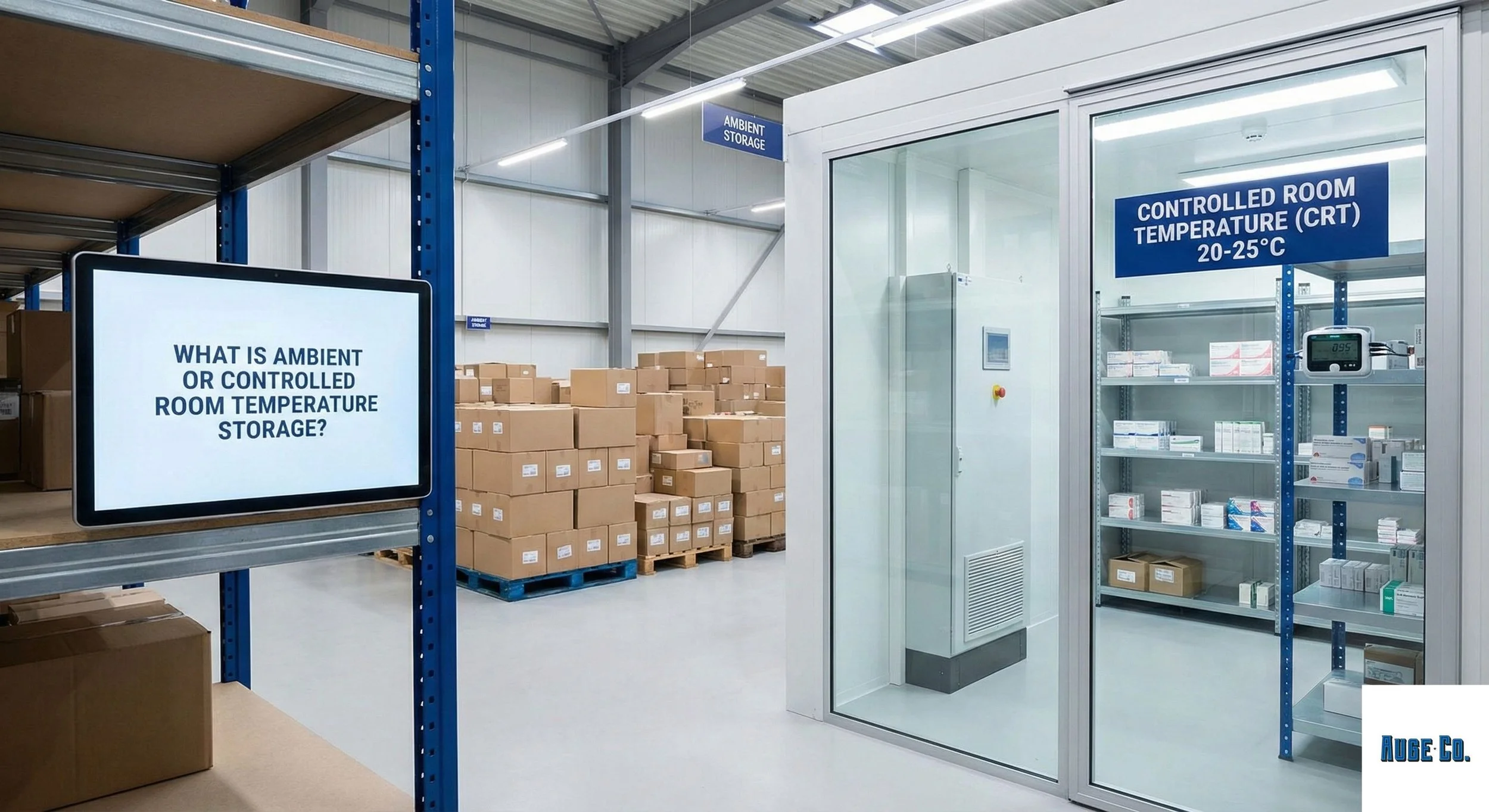
Ambient or controlled room temperature (CRT) storage refers to warehousing conditions maintained within a specific, non-refrigerated temperature range, typically between 15°C to 25°C (59°F to 77°F). While essential for shelf-stable goods, its most critical role is as the default environment products enter during a cold chain failure, where a lack of excursion data can lead to catastrophic product loss and safety risks.
Moving Beyond the Basic Definition: The Real Risk of Ambient Temperatures
When most people ask, "what is ambient storage in a warehouse?" they're thinking about dry goods, canned foods, or electronics. They envision a clean, secure space protected from extreme weather. This is the simple answer, but it misses the most crucial point for high-value industries. The real conversation isn’t about planned ambient storage for products like dietary supplements or cosmetics; it's about the unplanned, accidental exposure of temperature-sensitive products to these conditions. This is where the difference between ambient and cold chain storage becomes a critical point of failure.
For logistics professionals managing pharmaceuticals, biologic, and other sensitive goods, ambient temperature is not a storage strategy—it’s a risk state. It's what happens when a refrigerated truck breaks down, a power failure hits a storage facility, or a container sits on a tarmac for too long. Across the globe, billions of dollars worth of pharmaceutical products are stored and shipped at improper temperatures, making some drugs ineffective or even harmful. This is the true impact of misunderstanding what ambient controlled means in a high-stakes supply chain.
So, what qualifies as ambient conditions? Generally, it's the surrounding temperature of an environment. However, in logistics, we must be more precise. The term often used is controlled room temperature, or CRT. What does CRT stand for in logistics? It refers to a actively managed environment. The controlled room temperature USP definition (United States Pharmacopeia) specifies a range that prevents degradation. The spectrum for 'temperature-controlled' transport includes ambient, or controlled room temperature, which is defined as 20°C to 25°C (68°F to 77°F). Maintaining 20-25 C in a warehouse is not a passive act; it requires robust warehouse HVAC systems for CRT and constant temperature monitoring for product storage.
The Myth of Uniform Stability: Why Excursion Tolerance Is Product-Specific
A common and dangerous assumption is that a temperature excursion—a deviation from the required storage conditions—is an automatic death sentence for a product. When a cold chain is breached, the default action is often to discard the entire shipment. This is driven by a lack of precise data and a justifiable fear of compromising patient safety. The high cost of uncertainty forces a conservative, wasteful approach.
However, research and experience show a more nuanced reality. Product integrity and temperature control are not a simple on/off switch. The stability of a product when exposed to room temperature varies dramatically. Factors include the product's formulation, its packaging, and the duration and severity of the excursion. In fact, one study reviewing 150 refrigerated medications found that 22.8% of the products remained stable for at least 24 hours when exposed to room temperature. This highlights a critical information gap: logistics providers and end-users rarely have access to the specific excursion data from manufacturers needed to make an informed decision.
This lack of transparency leads to millions in unnecessary disposal. Imagine two different brands of the same biologic. One may degrade after only four hours at ambient temperature, while the other might remain perfectly stable for 30 hours. Without that specific data, both are treated as compromised, and both are destroyed. Understanding the specific CRT storage requirements for pharmaceuticals is not enough; we need to know what happens when those requirements are temporarily unmet.
The High Cost of Uncertainty: Product Disposal and Patient Risk
The financial implications of improper product storage temperature are immense. Beyond the direct cost of discarded goods, there are the costs of replacement, reshipment, and the administrative burden of investigation. For clinical trials, a single lost shipment can delay a study by months, costing millions and slowing the path to new treatments. This is the tangible cost of failing to manage the ambient temperature supply chain.
The greater risk, however, is to patient safety. Unintentional exposure of refrigerated medications to room temperature can occur during transport delays or handling errors, which raises concerns about compromised potency and patient safety. An ineffective vaccine, a degraded biologic, or a compromised therapeutic can have devastating consequences. The pressure to avoid this outcome is precisely why so much perfectly viable product is destroyed. Without data, the risk is simply too high. This is why robust pharmaceutical warehousing standards and cGMP compliant ambient warehousing practices are non-negotiable.
From Reactive to Proactive: Managing Ambient Temperature as a Predictable Risk
Instead of viewing a temperature excursion as an unforeseen catastrophe, forward-thinking logistics partners treat it as a manageable, predictable risk. This shift from a reactive to a proactive mindset is the cornerstone of modern temperature-managed logistics solutions. Here are the practical strategies to achieve this:
Comprehensive Data and Documentation: The first step is to demand better stability and excursion data from manufacturers. A true 3PL with controlled room temperature capabilities will work with clients to build a library of product-specific temperature tolerances. This is the foundation of an intelligent temperature control in supply chain management.
Advanced Monitoring and Alerting: Deploying ambient temperature data loggers on all sensitive shipments is no longer optional. These devices provide a second-by-second account of the conditions inside a container, offering definitive proof of whether a product’s specific temperature range was breached and for how long.
Contingency Planning and Infrastructure: What happens when an alert is triggered? A proactive logistics partner has a plan. This includes having access to secure controlled room temperature storage facilities nationwide for temporary holding. It means having teams ready to intervene, assess, and if necessary, salvage a shipment. For one of our clients, a simple mechanical failure could have meant a total loss. “These guys are the BEST! Helped me out when our driver's clutch went out! Unloaded and loaded our new driver in no time! Reach out to them if you're ever in a pinch.” This kind of rapid response turns a potential disaster into a manageable logistical challenge.
Warehouse Validation and Mapping: For planned CRT storage, you can't just rely on the thermostat. A critical practice is performing regular warehouse temperature mapping for CRT. This process identifies hot and cold spots within a facility, ensuring that every pallet location remains within the specified 15 to 25 degrees Celsius range year-round. This is a key part of CRT warehouse validation.
Key Factors in Your Storage Strategy
When evaluating your logistics, whether for pharmaceuticals, nutraceutical storage temperature requirements, or even controlled room temperature for fine art, the conversation must go deeper than just cost per pallet. Here are the crucial decision factors:
Product-Specific Temperature Stability Data
Challenge: Most manufacturers are hesitant to release detailed excursion data, fearing liability. This leaves logistics providers and customers in the dark during a deviation.
Solution: Partner with a 3PL that actively advocates for and helps you acquire this data. Having this information on hand before an incident occurs is the single most effective way to prevent unnecessary product loss.
Contingency Planning for Cold Chain Failures
Challenge: A standard freight carrier's plan for a truck breakdown is to wait for a repair. This is unacceptable for temperature-sensitive products.
Solution: Your logistics partner must have a documented, tested contingency plan. This includes 24/7 monitoring, crisis intervention teams, and a network of pre-vetted, secure ambient storage facilities to protect products during a delay.
Cost of Robust Monitoring vs. Risk of Product Loss
Challenge: Advanced data loggers and 24/7 monitoring services add to the upfront cost of shipping.
Solution: Compare this incremental cost to the total value of your shipment. For a high-value biologic, the cost of monitoring is a tiny fraction of the potential loss. It's an insurance policy against a multi-million dollar write-off.
Impact of Excursions on Patient Safety and Product Efficacy
Challenge: The ultimate risk is not financial, but human. A compromised product that reaches a patient can be ineffective or harmful.
Solution: This is a non-negotiable priority. A robust quality management system, validated procedures, and an unbroken chain of custody and temperature data are essential to guarantee that the product delivered is the product that was intended.
Making the Right Choice for Your Needs
There is no single "best" solution; the right strategy depends on your specific role and the products you manage. The choice between standard dry storage vs controlled room temperature, or cold chain vs. CRT, depends entirely on the product's requirements and your organization's tolerance for risk.
For the Pharmaceutical Logistics Manager:
Your primary concern is regulatory compliance (e.g., cGMP), product integrity, and cost-efficiency at scale. You need a partner who understands pharmaceutical ambient storage regulations and can provide validated, year-round controlled room temperature warehousing. Focus on partners who can demonstrate robust CRT warehouse validation, comprehensive temperature mapping, and have clear SOPs for handling excursions. Your key question should be: "Show me your excursion management protocol."
For the Clinical Trial Supply Coordinator:
You are managing irreplaceable products where a single loss can derail a trial. Your priority is absolute risk mitigation. You require a partner with flawless execution in logistics for temperature-sensitive products, including granular, real-time tracking and a documented chain of custody. The cost of controlled room temperature storage is secondary to the cost of trial failure. Seek out a controlled room temperature 3PL provider that specializes in high-value, high-consequence logistics.
For the Biorepository/Biobank Manager:
You are responsible for long-term storage of invaluable biological samples. While much of your inventory is under cold chain or cryogenic storage, inbound and outbound logistics are points of vulnerability. Your need for secure controlled room temperature storage is often for transient periods during transport or processing. Your ideal partner provides on-demand, validated CRT services and understands the unique handling requirements of biological materials.
Ultimately, understanding ambient and controlled room temperature storage is about shifting your perspective from a simple definition to a sophisticated risk management strategy. It's about recognizing that the greatest threats often lie in the moments between controlled environments. At Auge Co. Inc., we have built our reputation on managing these critical moments. Our expertise in temperature-managed logistics solutions ensures that your products are protected by proactive planning, advanced technology, and a team that is ready to act when the unexpected happens. For a comprehensive assessment of your supply chain's temperature-related risks, contact our logistics experts at our headquarters in San Antonio, TX today.