
Why San Antonio is the ideal location for cross-docking operations
San Antonio, TX is the premier location for cross-docking operations not just because of its geography, but due to a deliberate, multi-decade transformation. This has created a purpose-built logistics ecosystem, combining strategic infrastructure like Port San Antonio and major intermodal terminals to specifically accelerate freight along the US-Mexico trade corridor.
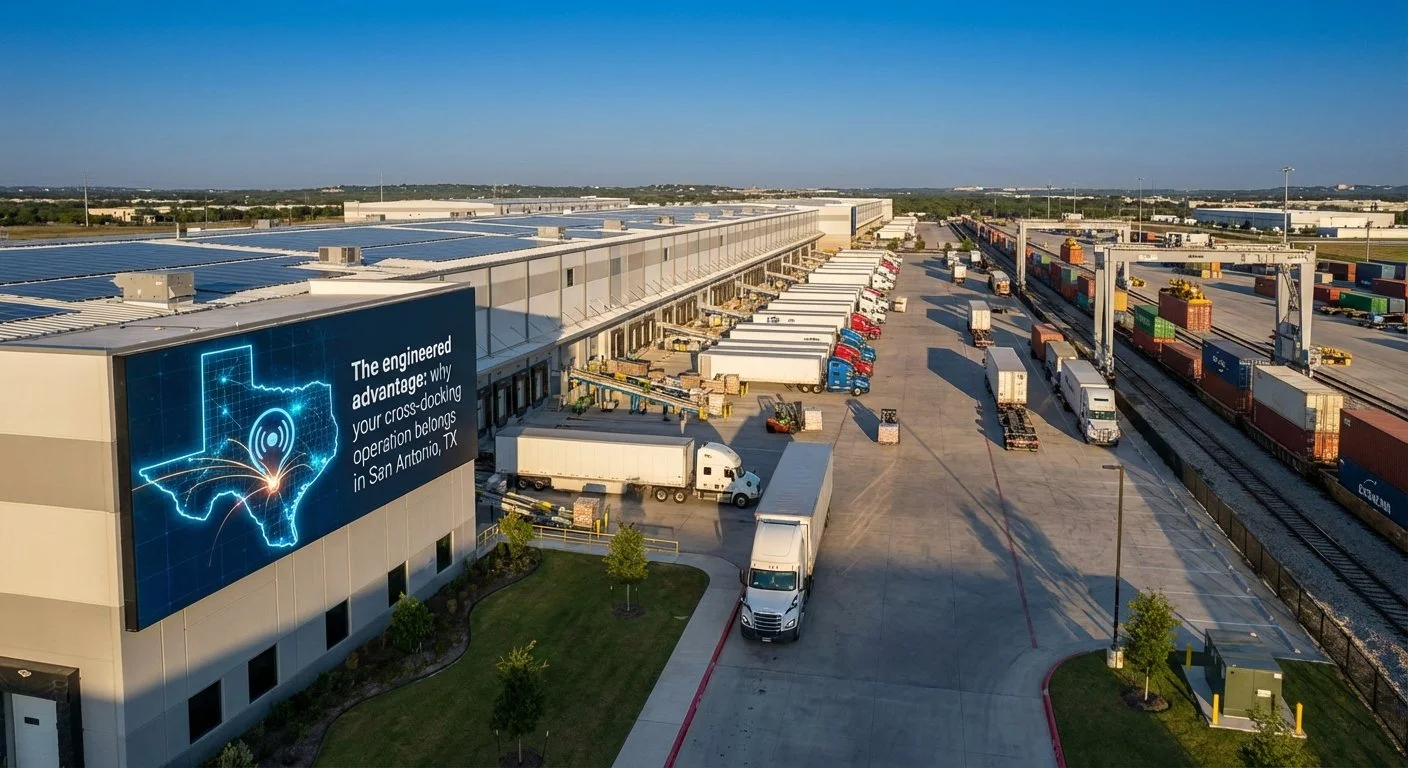
Beyond the Crossroads: San Antonio's Engineered Logistics Dominance
For decades, logistics managers have looked at a map of North America and pointed to San Antonio, Texas as a natural choke point for trade. They aren't wrong. But to see this city as merely a convenient dot on a map is to miss the much larger, more compelling story. The truth is, San Antonio's supremacy as a cross-docking hub isn't an accident of geography; it's the result of a calculated, long-term strategy. It's an environment engineered from the ground up to solve the specific challenges of high-velocity supply chain management for businesses moving goods across the US-Mexico border.
This isn't just about highways intersecting. It's about a series of transformative decisions and massive infrastructure investments that have turned a geographic advantage into an unparalleled operational one. From the redevelopment of a former military base into a global logistics platform to the untangling of a critical rail bottleneck, the story of this city is the story of a supply chain hub being purposefully built. Understanding this evolution is the key to understanding why, for any business serious about efficiency, San Antonio is not just an option—it is the strategic imperative for cross docking excellence.
The Foundation of a Hub: How Decades of Strategy Forged a Cross-Docking Powerhouse
To fully grasp what is so special about San Antonio, Texas, we must look beyond its location and analyze the three pillars that support its logistics infrastructure. Each builds upon the last, creating a synergistic effect that no other city on the USMCA Trade Corridor can replicate. This combination of natural placement, targeted investment, and holistic ecosystem development is the core of its competitive edge.
Innate Geographic Advantage
The Pro: The most obvious advantage is San Antonio's position at the nexus of North America's primary trade arteries. San Antonio is located at the intersection of Interstate 10 (east-west) and Interstate 35, which traces the north-south NAFTA trade corridor from Laredo, Texas, to Canada. This places it as the first major metropolitan consolidation and distribution point for the immense volume of freight entering the U.S. through the Laredo and Eagle Pass ports of entry. For any FTL (Full-Truckload) or LTL (Less-Than-Truckload) shipping operation, this geographic advantage translates directly into reduced transit times and lower initial drayage services costs.
The Con: Geography alone is not a strategy. A great location without the capacity to handle the volume it attracts quickly becomes a bottleneck, not a hub. Heavy traffic, insufficient warehouse space, and a lack of multimodal options can erode any time savings gained from proximity. Many cities have a good location, but few have built upon it effectively.
Strategic Infrastructure Development
The Pro: This is where San Antonio began to separate itself from the pack. The city and its partners made targeted, high-impact investments to solve specific logistics problems. The most critical of these was addressing the intermodal bottleneck. For years, the lack of a unified rail terminal created massive operational inefficiency. In a stark example of this problem, prior to 2008, the lack of a unified intermodal facility required 80,000 semi-trucks annually to shuttle containers between two separate inner-city rail yards. This was an unsustainable drain on time, fuel, and resources.
The solution was a game-changer. In 2008, Union Pacific opened a $115-million, 350-acre San Antonio Intermodal Terminal to resolve a key logistics inefficiency, allowing direct access to both north-south and east-west rail lines. This single project created the seamless truck-rail fluidity essential for high-volume cross-docking and transloading services, allowing goods to flow from truck to train and back again without ever getting caught in urban congestion.
The Con: While vital, individual infrastructure projects can still result in a disconnected system. A world-class rail terminal is of limited use without sufficient industrial real estate, modern cross-dock facility designs, and a skilled labor force nearby. Building the parts is one thing; making them work together as a cohesive whole is another challenge entirely.
A Purpose-Built Logistics Ecosystem
The Pro: This is the final, most crucial pillar and San Antonio's defining characteristic. The city's leadership didn't just build infrastructure; they cultivated a complete logistics ecosystem. The crown jewel of this effort is Port San Antonio. The journey began when San Antonio's strategic transformation into a logistics hub was initiated in response to the closure of Kelly Air Force Base, which occurred around 2002. What could have been an economic disaster was turned into a historic opportunity. The former base was reimagined as a massive, 1,900-acre aerospace, cybersecurity, and advanced logistics campus.
Critically, Port San Antonio includes a designated Foreign Trade Zone (FTZ). For importers, this is a powerful tool. An FTZ allows foreign goods to be brought into the zone without formally entering U.S. commerce, deferring, reducing, or even eliminating customs duties until the goods leave the zone for their final destination. For cross-docking operations dealing with manufacturing components from Mexico, this means inbound freight can be processed, sorted, consolidated, and transferred with unprecedented speed and cost savings.
The Con: Creating a true ecosystem is a monumental undertaking that requires decades of sustained public-private partnership and immense capital investment. It is difficult to replicate and requires constant maintenance and forward-thinking to adapt to new trade policies like the USMCA and shifting supply chain dynamics like nearshoring.
The Anatomy of an Ideal Cross-Docking Operation in San Antonio, TX
Understanding San Antonio's strategic development is one thing; knowing what to look for on the ground is another. When evaluating a 3PL (Third-Party Logistics) partner or a cross-dock facility in the city, there are specific requirements that separate the truly efficient from the merely adequate. The key requirements for cross-docking are not just about having a warehouse; they're about having a high-velocity sorting and consolidation engine.
A premier San Antonio cross-docking operation should feature:
High Dock Door Ratios: A true cross-dock facility minimizes storage and maximizes flow. This requires a high number of dock doors relative to the total square footage, allowing for simultaneous unloading of inbound trucks and loading of outbound vehicles.
Extensive Yard and Trailer Storage Space: Ample yard space is non-negotiable. It allows for efficient staging of inbound and outbound trailers, preventing congestion at the dock doors and ensuring a fluid transition of freight.
Advanced Technology Systems: Operational efficiency is driven by data. Look for partners utilizing a robust Warehouse Management System (WMS) for inventory control and a Transportation Management System (TMS) for optimizing freight movements. Real-time tracking provides the visibility necessary for just-in-time (JIT) inventory management.
Proximity to Key Arteries: The facility itself must be strategically located with easy access to the I-35 corridor and the I-10 corridor, as well as the Union Pacific and BNSF Railway intermodal ramps. Every minute spent navigating local traffic is a minute of lost inventory velocity.
Specialized Service Capabilities: The modern supply chain is complex. A top-tier provider in San Antonio will offer more than just basic cross docking. This includes specialized solutions like cold chain logistics for perishable goods, transloading services between different container types, and drayage services to and from the port and rail yards.
The USMCA Funnel in Action: Why Your Freight Flows Faster Through San Antonio
The infrastructure and facilities in San Antonio, TX exist to serve a purpose: to be the essential acceleration point for goods flowing from Mexico's powerful maquiladora industry into the vast US market. The city acts as a funnel, taking in a wide variety of products and efficiently channeling them to their final destinations.
The Automotive "SuperCluster" and JIT Inventory
Central Texas, particularly the Austin-San Antonio corridor, is a booming hub for automotive manufacturing. This industry runs on a Just-In-Time (JIT) inventory model where automotive parts and manufacturing components must arrive at the assembly line within a very tight window. A delay of even a few hours can halt production, costing millions.
San Antonio's cross-docking operations are critical to this process. Trucks carrying components from various suppliers in Mexico converge in the city, where their loads are quickly consolidated onto outbound trucks destined for specific assembly plants, ensuring the continuous flow required for modern manufacturing.
From Field to Shelf: Protecting Perishable Goods
A significant portion of the fresh produce consumed in the United States, from avocados to berries, crosses the border at the Laredo Port of Entry. These perishable goods are on a strict timeline. San Antonio's logistics parks offer the specialized cold chain logistics required to maintain the integrity of this produce. Cross-dock facilities with refrigerated zones allow for the rapid transfer of these goods from long-haul trucks to regional distribution vehicles, minimizing time spent off-temperature and maximizing shelf life for retail distribution across the country.
The E-commerce Fulfillment Surge
With the rise of nearshoring, more businesses are manufacturing goods in Mexico for the booming US e-commerce market. San Antonio serves as the ideal entry point for this inventory. A centralized distribution strategy using a San Antonio cross-dock allows businesses to manage their inbound logistics from Mexico and their outbound order fulfillment to the entire US from a single, cost-effective location. This is particularly advantageous for reaching major markets like the Dallas-Fort Worth metroplex, Houston, and the rapidly growing Central Texas population, optimizing for both national distribution and last-mile delivery.
A Clear-Eyed View: Navigating the Realities of a Growing Hub
No successful, rapidly growing city is without its challenges. Questions sometimes arise, such as "Why are people moving out of San Antonio, TX?" and it's important to address them with transparency. Like many popular American cities, San Antonio has experienced rising housing costs and increased traffic congestion—the natural side effects of a booming economy and population growth. These are real concerns for residents.
However, from a business and logistics perspective, these challenges are symptoms of the city's success, and the benefits of living and operating in San Antonio remain incredibly strong. Compared to other major Texas hubs like Austin or Dallas, San Antonio still offers a significantly lower cost of living and more affordable operating costs. This pro-business environment makes it easier to ensure labor force availability, a critical component for any large-scale warehousing or distribution operations. The city's strategic planning continues to address infrastructure needs, ensuring that the logistics sector can continue to thrive. The benefits of a stable, available workforce and lower overhead create a resilient and cost-effective foundation for any supply chain hub.
Key Decision Factors for Your San Antonio Logistics Partner
When selecting a 3PL partner for cross-docking services in San Antonio, your decision should be based on a clear set of operational criteria. At Auge Co. Inc, we believe in empowering our clients with the right information to make a confident choice. Here are the factors that truly matter:
Proximity to the US-Mexico Trade Corridor
This is the baseline requirement. Your partner must be positioned to minimize the distance and time from the Laredo and Eagle Pass border crossings. This directly impacts drayage costs, fuel expenses, and, most importantly, the speed at which your inventory enters the distribution cycle, leading to significant cost savings and reduced transit times.
Access to Multimodal Transportation
A top-tier location offers options. Look for facilities with immediate access not just to the I-35 and I-10 interchange but also to the major rail terminals of Union Pacific and BNSF Railway. This flexibility is key to supply chain resilience, allowing you to pivot between truck and rail to manage costs, capacity, and shipping deadlines.
Efficiency of Modern Intermodal Facilities
Your partner should be plugged into the city's most efficient infrastructure. This means having established processes for interacting with Port San Antonio's Foreign Trade Zone for rapid customs clearance and leveraging the speed of the San Antonio Intermodal Terminal. This ensures your freight isn't just in the right city, but is moving through its fastest channels, enhancing operational efficiency.
Availability of Specialized Services
Problems happen in logistics. Your partner's value is measured by how they solve them. Do they offer temperature-controlled environments for cold chain logistics? Can they perform transloading and load restacking when a container is overweight or shifted? These ancillary services are what keep your supply chain moving when exceptions occur, turning a potential disaster into a minor delay.
Making the Right Choice for Your Needs
The ideal San Antonio cross-docking solution is not one-size-fits-all. The right partner and strategy depend entirely on your specific role and objectives within the supply chain. Here's how different professionals can leverage the city's unique advantages:
For the US Importer's Logistics Manager
Your primary needs are speed, visibility, and reliability. You require a partner in San Antonio that acts as a seamless extension of your inbound supply chain. The priority is a facility within the Foreign Trade Zone at Port San Antonio to expedite customs clearance for goods arriving from Mexican maquiladoras. You need a provider with a robust WMS that offers real-time tracking from the moment a truck arrives, through the sorting and consolidation process, and onto the outbound carrier for distribution across the US. Your goal is to maximize inventory velocity and minimize the time from border crossing to final delivery.
For the Mexican Exporter's Supply Chain Director
Your focus is on an efficient and cost-effective entry point into the entire US market. San Antonio is your strategic beachhead. You need a cross-docking partner who specializes in freight consolidation, taking LTL shipments from multiple origin points in Mexico and building them into more economical FTL shipments destined for different regions of the US. Access to both east-west (I-10) and north-south (I-35) transportation arteries from a single hub is paramount. This centralized distribution model simplifies your US logistics, reduces handling costs, and improves market access.
For the Freight Broker or 3PL Operator
You seek capacity, flexibility, and problem-solving capabilities. Your reputation depends on your ability to find solutions when things go wrong. San Antonio is a target-rich environment for carriers, giving you options and competitive pricing. You need a local partner who can act as your hands and feet on the ground. A partner who can respond instantly to urgent needs is invaluable. As one of our own clients experienced: "These guys are the BEST! Helped me out when our driver's clutch went out! Unloaded and loaded our new driver in no time! Reach out to them if you're ever in a pinch. Alicia was AWESOME! 10/10!!!" This is the level of service you need: a partner who can provide transloading, short-term warehouse space, and drayage services at a moment's notice to keep your client's freight moving and protect your relationship.
Ultimately, the best choice depends on a thorough analysis of your supply chain's unique demands, from the types of goods you ship to your final delivery destinations. The strategic ecosystem built in San Antonio, TX provides the tools; the right partner helps you wield them effectively.
For a personalized assessment of your cross-docking needs and a clear, actionable plan to improve your operational efficiency, contact the expert team at Auge Co. Inc today.