
The role of cross-docking in cold chain logistics
The primary role of cross-docking in cold chain logistics is to accelerate product flow by moving temperature-sensitive goods directly from inbound to outbound transportation, minimizing storage time. However, its most strategic function is evolving: transforming the dock into a data-driven quality control point to actively reduce spoilage and optimize distribution.
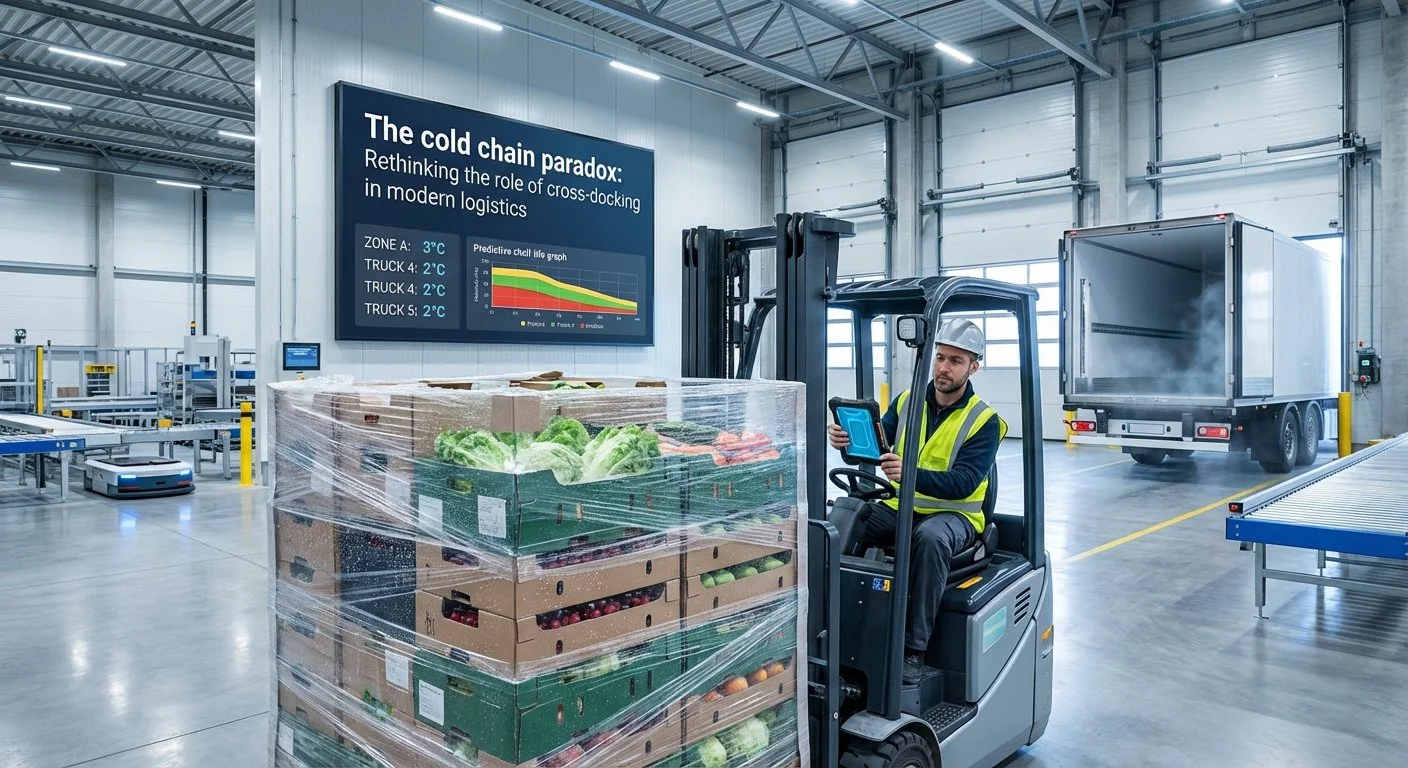
The Cross-Docking Paradox: Where Speed Meets Vulnerability
In the world of temperature-controlled logistics, speed is paramount. Every minute a pallet of fresh produce, pharmaceuticals, or frozen goods spends sitting on a dock is a minute it's exposed to potential risk. This is precisely why cross-docking is a supply chain strategy designed to eliminate unnecessary storage, transferring products directly from unloading and receiving to outbound trucks. For many businesses, the main purpose of cross-docking has been to reduce inventory holding costs and shorten lead time, a cornerstone of Just-In-Time (JIT) inventory management. The process is lean, efficient, and on the surface, a perfect solution for the fast-paced demands of the cold chain.
However, this point of greatest speed is also the point of greatest vulnerability. The staging area of a cross-docking facility, bustling with forklift operations and material handling equipment, is where the cold chain is most likely to be broken. A slight delay in dock scheduling, an unexpected issue with a reefer truck, or simple human error can lead to a temperature excursion. For perishable products like meat, freshness is strongly influenced by temperature, and even a brief deviation can initiate a cascade of quality degradation, ultimately leading to spoilage and waste before the product ever reaches the consumer.
This is the cross-docking paradox: the very process designed to protect product integrity through speed can become its biggest threat if not managed with surgical precision.
Understanding the Core Process and Its Variations
At its heart, cross-docking is a logistics maneuver where products spend minimal time—typically less than 24 hours—at a distribution center. Goods arrive via inbound logistics, often in full truckload (FTL) quantities, are sorted, and then consolidated onto outbound vehicles for last-mile delivery, often as less-than-truckload (LTL) shipping. This flow-through distribution model is a key component of lean logistics, designed to optimize the supply chain network.
There are several approaches to this strategy, but they generally fall into three categories:
Manufacturing Cross-Docking: This involves receiving purchased and inbound materials required for production. A warehouse might receive these goods and prepare sub-assemblies for the production orders.
Distribution Cross-Docking: This common practice involves consolidating inbound products from different vendors into a mixed product pallet, which is then delivered to the customer when the final item is received.
Opportunistic Cross-Docking: A flexible approach where a facility can route a product directly from the receiving dock to an outbound shipping dock to meet a known demand, bypassing storage entirely.
This strategy is highly effective for businesses with high-volume, predictable product flow, such as those in grocery retail logistics or the Quick Service Restaurants (QSR) supply chain. But relying on speed alone is a reactive posture. The future of cold chain management requires a proactive shift.
From Passive Transit Point to Active Quality Hub
The conventional approach to cross-docking treats the facility as a simple transfer station. Temperature is monitored, often passively with data loggers, but the primary goal is throughput. This mindset misses a critical opportunity. The dock is the last, best chance to gather intelligence on product condition before it's sent out for final delivery.
By evolving the cross-dock into a data-driven quality control hub, we can move from simply hoping for the best to actively ensuring it.
This transformation hinges on integrating real-time data with advanced analytics directly into the dock workflow. Instead of just noting the temperature on arrival, modern facilities utilize IoT sensors and RFID technology to gain continuous supply chain visibility. This data can be fed into a sophisticated Warehouse Management System (WMS) or Transportation Management System (TMS) to create a dynamic picture of each product's journey.
The real game-changer, however, is the application of predictive shelf-life models. Academic research has shown that predictive quality tracing models for perishable goods can be developed by combining temperature history with established biological decay rates. When this intelligence is applied at the cross-dock, it allows for a monumental shift in distribution philosophy.
From FIFO to FEFO: The Dawn of Quality-Driven Distribution
For decades, the logistics industry has operated on a "First-In, First-Out" (FIFO) basis. It's simple and logical. But it's also blind to the actual condition of the product. A pallet of dairy products that arrived today but experienced a slight temperature fluctuation during transportation might have less remaining shelf life than a pallet that arrived yesterday under perfect conditions. FIFO would send the older, yet higher-quality pallet out first, risking spoilage for the more recently arrived but compromised goods.
By leveraging real-time data and predictive analytics at the dock, businesses can adopt a "First-Expiry, First-Out" (FEFO) strategy. This is quality-driven distribution.
Here's how it works:
Data Capture: As inbound carriers arrive, sensors on pallets of fresh produce, meat and poultry, or pharmaceuticals transmit their complete temperature history.
Quality Assessment: The WMS analyzes this data against predictive shelf-life models, instantly calculating the actual remaining shelf life for that specific batch.
Intelligent Routing: Instead of being queued by arrival time, products are prioritized for outbound logistics based on their calculated expiry window. A pallet with a shorter remaining life can be expedited to a nearby location, while a pallet with a longer life can be safely routed on a longer journey.
This approach directly aligns with modern solutions to enhance product distribution, which are designed to maximize freshness and selling time. It turns the cross-docking process from a simple sorting and consolidation exercise into a strategic decision-making center that actively preserves product integrity and value.
Comparing Cold Chain Strategies: Storage vs. Cross-Docking
Choosing the right logistics strategy depends entirely on a company's specific needs, product types, and supply chain complexity. Let's compare the traditional cold storage warehouse against the two primary modes of cross-docking.
Traditional Long-Term Cold Storage
This is the classic model for inventory management, where goods are received, put away in a cold storage warehouse, and held until an order is placed. It's ideal for buffering against demand uncertainty and storing products with a longer shelf life, like certain frozen foods. However, it incurs significant inventory holding costs, increases handling, and can obscure the real-time condition of products sitting in storage.
Cross-Docking as a Speed-Focused Transit Point
This approach prioritizes operational efficiency and throughput. The goal is to minimize dwell time and reduce transportation costs by consolidating freight. It excels at accelerating the supply chain but offers limited quality assurance beyond basic temperature checks. The primary risk is that it can inadvertently speed a compromised product toward the end consumer without intervention, mistaking speed for safety.
Cross-Docking as a Data-Driven Quality Control Hub
This advanced model incorporates the speed of traditional cross-docking but adds a crucial layer of intelligence. It leverages real-time temperature monitoring and predictive shelf-life data to make smarter distribution decisions. This method actively mitigates supply chain risks by identifying potential issues at the dock and routing products based on their actual quality, not just their arrival time. While it requires investment in technology like IoT sensors and a robust WMS, it offers the highest potential for reduction of product spoilage and waste.
The True ROI: Beyond Speed and into Spoilage Reduction
While many third-party logistics (3PL) providers focus on the efficiency gains of cross-docking, the most significant return on investment comes from what doesn't happen: waste.
Food waste is a staggering financial drain and a reputational liability. A data-driven cross-docking strategy directly combats this by preventing compromised products from continuing their journey.
Think of the financial impact. A single rejected truckload of high-value seafood logistics or pharmaceuticals can wipe out the efficiency savings of an entire quarter. By identifying a potential temperature excursion at the dock, a company can take corrective action immediately—whether that involves reverse logistics or rerouting—preventing a costly rejection at the final destination.
This focus on quality doesn't mean sacrificing speed. In fact, a well-run, data-driven facility can be incredibly responsive. As one of our partners noted after a vehicle breakdown threatened their delivery schedule, "These guys are the BEST! Helped me out when our driver's clutch went out! Unloaded and loaded our new driver in no time!" This proves that meticulous quality control and rapid response can and should coexist. The goal is not just to be fast, but to be intelligently fast.
Making the Right Choice for Your Needs
No single logistics strategy is universally superior. The optimal approach depends on your specific role, priorities, and position within the cold supply chain.
For the Logistics Manager at a Large Grocery Retailer
Your primary focus is minimizing in-store waste (shrink) and ensuring the freshest possible product is on the shelf to drive sales. A data-driven cross-docking hub is your most powerful ally. The ability to implement a FEFO strategy ensures that products with the shortest remaining shelf life are sold first, directly reducing the amount of expired product that has to be discarded. This not only improves your bottom line but also enhances customer satisfaction.
For the Quality Assurance Director at a Food Producer
Your concern is brand reputation and product integrity from production to consumption. You need verifiable proof that your goods were handled correctly according to Food Safety Modernization Act (FSMA) and Hazard Analysis and Critical Control Points (HACCP) guidelines. A partnership with a 3PL that operates a data-driven hub provides you with invaluable supply chain visibility. The real-time data and quality checks at the dock serve as a critical control point, safeguarding your brand against a recall or safety incident.
For the Supply Chain Innovator at a 3PL Company
You are looking to differentiate your services in a competitive market. Simply offering space and speed is no longer enough. By investing in the technology to transform your cross-docking facilities into intelligent quality hubs, you create a powerful value proposition. You can offer clients not just transportation management, but active risk mitigation and waste reduction. This positions your company as a forward-thinking partner, capable of solving your clients' most pressing financial and operational challenges.
Ultimately, the evolution of the cross-dock from a simple transit station to an intelligent quality hub represents the future of cold chain logistics. It's a strategic shift that prioritizes product integrity and waste reduction over mere speed, delivering far greater value to everyone in the supply chain.
At Auge Co. Inc, we have built our reputation on this principle of intelligent, reliable logistics. With decades of experience, we've seen firsthand how a proactive, data-driven approach transforms supply chain outcomes. For businesses ready to move beyond the limitations of traditional cross-docking, our team in San Antonio, TX, is equipped to design a solution that protects your products, your brand, and your bottom line. Contact us today for a comprehensive assessment of your cold chain needs.