
How Long Does Cross-Docking Take? A Realistic Timeline
Quick Summary
True cross-docking completes in 24 hours or less. Same-day transfers finish in as little as 2 hours when carriers are pre-staged.
Timeline is determined by carrier synchronization, shipment complexity, and cold chain requirements, not facility speed alone.
Emergency cross-docking depends on provider availability at 2 a.m. on a Sunday, not average floor time.
Auge Co Inc operates three San Antonio facilities with 24/7 responsiveness built for both planned transfers and breakdown scenarios.
The real answer to how long cross-docking takes depends on shipment type, facility readiness, carrier coordination, and whether your freight is temperature-controlled. Before you commit a load to a crossdock operation, you need numbers you can plan around.
This article breaks down cross-docking timelines by scenario, explains what causes delays, and tells you what to ask a provider before the truck rolls in.
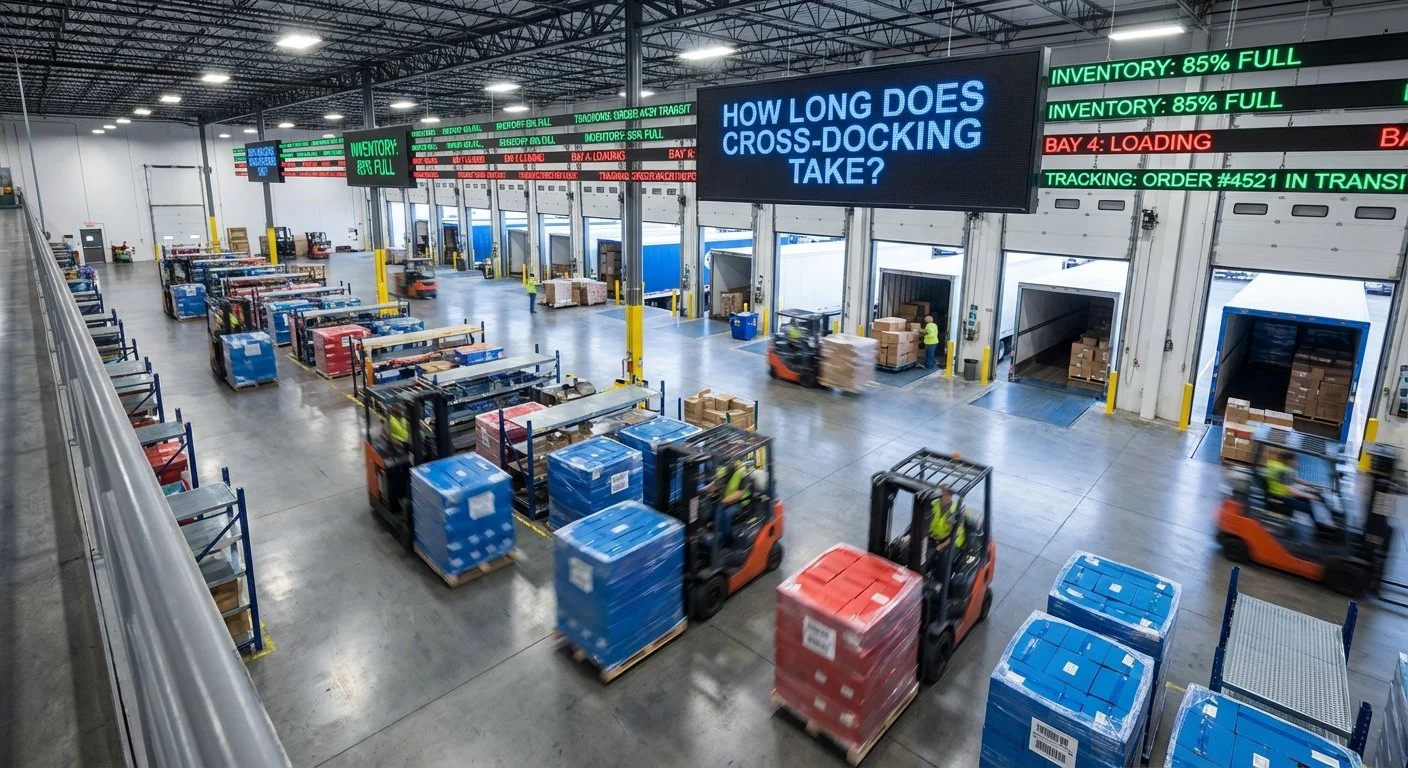
Cross-Docking Takes 24 Hours or Less at Its Fastest
In a true crossdocking operation, inbound freight arrives at a dock door, is sorted or consolidated on the floor, and rolls out on an outbound trailer without entering long-term storage. That floor time, called dock-to-stock time even when no storage is involved, typically runs between a few hours and 24 hours.
Industry benchmarks by scenario:
Same-day cross-dock: 2 to 6 hours. Freight arrives, is sorted by destination, and loaded onto waiting outbound carriers. Requires outbound trucks to be staged and ready.
Next-day cross-dock: 12 to 24 hours. Freight is held overnight on the dock floor as outbound carriers are confirmed or consolidated. Common for LTL consolidation scenarios.
Extended crossdocking: 24 to 72 hours. Freight waits for a partial truckload to fill or holds for a retailer's scheduled delivery window. Still considered cross-docking if it never enters racked storage.
Anything beyond 72 hours starts to blur into short-term warehousing. That distinction matters for cost, billing, and cold chain compliance.
What Drives Cross-Docking Speed (and What Causes Delays)
Speed in cross dock freight handling comes down to five variables. Most delays trace back to at least one of them.
1. Carrier Synchronization
Cross-docking requires inbound and outbound carriers to line up within a tight window. When an inbound truck arrives and the outbound is not staged, freight sits. That sitting time is often counted as a cross-docking problem when it is a scheduling problem.
Facilities with active dock scheduling software and direct carrier communication close this gap. Facilities relying on manual coordination add friction at every handoff.
2. Shipment Complexity
A single full truckload destined for one receiver is fast. A mixed pallet of perishables, dry goods, and hazmat sorted across six outbound destinations takes longer. Material handling complexity scales with SKU count, packaging condition, and whether restacking or repackaging is required.
If a load arrives shifted or damaged, add time for pallet restacking and cargo reorganization before sorting can begin. This is not rare on long-haul or reefer shipments where cargo settles in transit.
3. Temperature Requirements
Refrigerated cross-docking adds constraints that dry freight does not face. The dock environment has to stay compliant as freight moves from reefer to dock to outbound trailer. Pre-cooling outbound trailers, maintaining chain-of-custody documentation, and managing dwell time for temperature-sensitive product all add time.
A facility without proper refrigerated dock management can compromise product integrity even if the physical transfer takes 90 minutes. Cold chain compliance is a process requirement, not an afterthought.
4. Order Fulfillment Accuracy
Every outbound load needs to match a manifest. Scanning, verification, and load documentation add time, but skipping them costs more: chargebacks, short-ships, or rejected deliveries at the destination dock. Facilities with barcode scanning and real-time inventory visibility move faster through this step without cutting corners on order fulfillment accuracy.
5. Facility Layout and Staff Availability
A straight-line dock with double doors on each side of a wide staging floor moves freight faster than a facility requiring forklifts to travel long distances between dock positions. Staff availability on weekends, holidays, or for emergency loads determines whether a 4-hour cross-dock turns into a 16-hour wait.
When Cross-Docking Speed Becomes a Crisis Decision
The scenarios where timeline matters most are the ones nobody planned for.
A reefer breaks down at a truck stop. A cargo transport is stuck waiting on a connecting carrier that canceled. A driver is out of hours with a full load that needs to reach a distribution center before morning. In those moments, the question is not "how long does cross-docking take?" It is "who picks up the phone right now?"
Provider selection becomes a supply chain optimization decision, not a rate comparison. A facility operating 24 hours a day with staff who can stage an emergency load at 2 a.m. on a Sunday is operationally different from one that runs two shifts and closes weekends.
Auge Co Inc has built its reputation in San Antonio on these rescue scenarios. Cory and Alicia run an operation that responds when other providers do not. Reviews describe breakdowns, reefer failures, and clutch failures handled the same day, sometimes within hours. That responsiveness is the result of 30 years operating as a family business where the owners are directly accountable for every load that moves through the door.
For freight that cannot wait, Auge's crossdock operations across three San Antonio locations mean there is always a staging option close to the corridor you need.
Cross-Docking Timelines by Freight Type
| Freight Type | Typical Floor Time | Key Variable |
|---|---|---|
| Full truckload, single destination | 2-4 hours | Outbound truck staged and ready |
| LTL consolidation | 12-24 hours | Waiting for outbound load to fill |
| Refrigerated / perishables | 4-8 hours | Cold chain dwell time management |
| Mixed pallet (multi-SKU) | 6-12 hours | Sorting, scanning, load verification |
| Emergency / breakdown transfer | 2-6 hours | Provider availability, not process speed |
These are realistic ranges, not guarantees. The closest estimate comes from a facility that asks the right questions before the truck rolls in.
What Cross-Docking Does Not Fix
Cross-docking optimizes the terminal transfer. It does not fix carrier transit time, port delays, or a late inbound truck. If your inbound freight runs four hours behind schedule, your cross-dock timeline shifts by four hours regardless of how efficient the facility is.
Cross-docking is not a substitute for cargo handling services and freight consolidation when multiple origins feed a single outbound lane. Consolidation takes longer by design. It waits for partial loads to reach a viable full truckload, but delivers better per-unit freight cost. Confusing the two leads to the wrong tool for the job.
For shipments moving on partial trailers, less-than-truckload shipping operates on carrier network cycles that may not align with the urgency window of a direct cross-dock transfer.
Knowing which service fits the shipment is the first decision. Timeline follows from that.
Questions to Ask a Cross-Docking Provider Before You Commit a Load
Not all facilities operate the same way. These questions surface the difference.
On timing:
What is your average floor time for a load of this type?
Do you have outbound carrier staging available, or do we coordinate that separately?
What is your cutoff time for same-day cross-dock?
On temperature:
Are your dock doors refrigerated, and can you maintain cold chain during transfer?
How do you document temperature compliance during the handoff?
On availability:
Do you operate on weekends and holidays?
Who do we call if there is an emergency with an inbound load?
On material handling:
Can you handle a shifted or damaged load, and what does that add to the timeline?
Do you offer load restacking on-site if pallets need to be rebuilt before outbound loading?
A provider who answers these directly, without routing you to a general inquiry form, is set up for the kind of freight forwarding relationship that actually works.
San Antonio Cross-Docking: Three Locations, One Phone Call
San Antonio sits at the intersection of I-10, I-35, and US-90. A significant share of cross dock traffic in South Texas routes through this market.
Auge Co Inc operates three facilities across the city: North San Antonio along the PanAm Expressway, Southeast along Loop 410, and Central on Brazos Street. That geographic spread means inbound freight from any corridor has a facility close to the receiving dock or next carrier pickup point.
For refrigerated cargo, Auge's cold chain warehousing keeps the temperature-sensitive side of the supply chain covered without moving freight across town to find a compliant dock.
For planned cross-dock moves in San Antonio or emergency transfers on short notice, dock-to-stock services at Auge Co Inc are built for both.
For more context on how cross-docking fits a temperature-controlled supply chain, see the role of cross-docking in cold chain logistics. For a breakdown of operational approaches, the five types of cross-docking covers the distinctions.
Cory Stehr is the operations lead at Auge Co Inc, a family-owned cold storage and logistics company serving all of Texas from three San Antonio warehouse locations since 1996. With direct involvement in every aspect of the operation, from refrigerated warehousing to emergency cross-dock transfers, Cory brings hands-on expertise to the freight and cold chain challenges Texas businesses face daily.